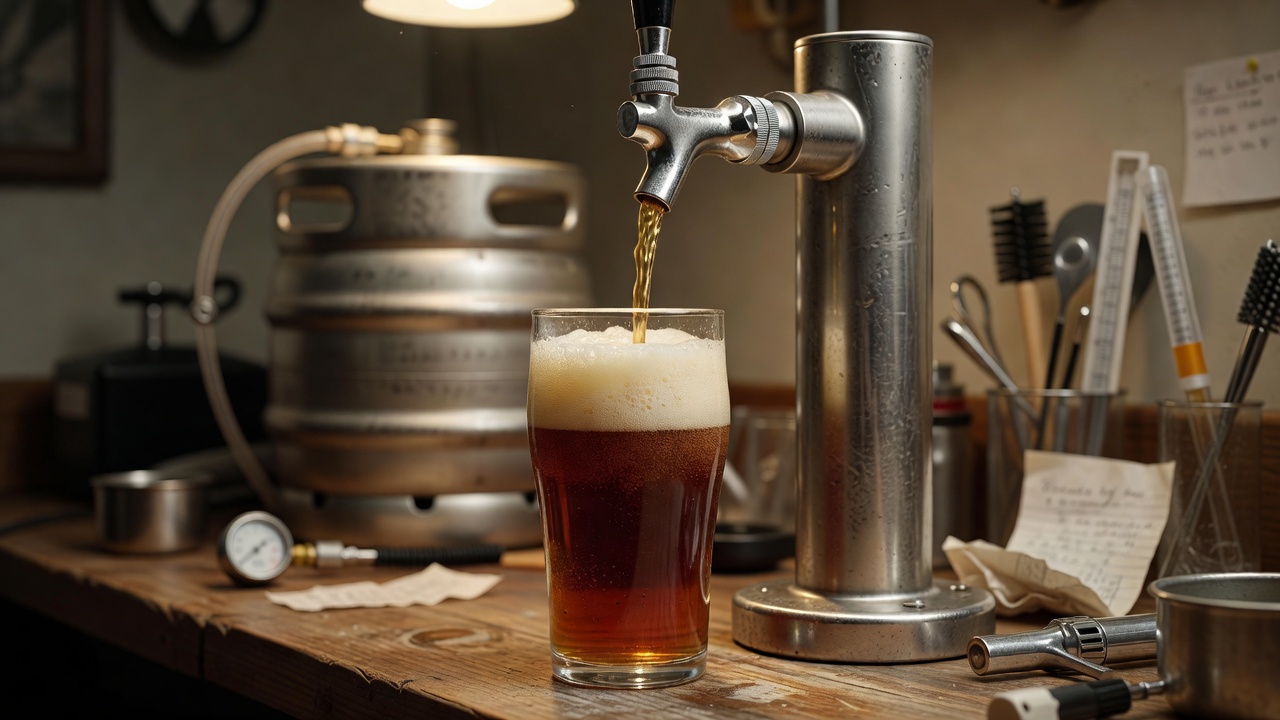
After weeks of carefully mashing, boiling, chilling, and fermenting, you are left with five gallons of flat beer. The final step is packaging and carbonation. For generations of home brewers, this meant one thing: bottling. However, as home draft equipment has become more accessible, many brewers are faced with a choice: stick to the traditional, inexpensive bottle, or invest in a kegging system.
Both methods are entirely capable of producing competition-winning beer. The decision largely comes down to your budget, available space, and how much time you are willing to spend cleaning.
The Bottling Process
Bottling relies on a process called bottle conditioning. You add a carefully measured amount of sugar to your flat beer right before sealing it in bottles. The residual yeast in the beer consumes this sugar, producing carbon dioxide. Because the bottle is sealed, the CO2 has nowhere to escape and is forced into the liquid, carbonating the beer.
Pros of Bottling:
- Low Entry Cost: All you need are empty pry-off bottles, a capper, some caps, and a siphon. Most starter kits include everything required.
- Easy Distribution: If you want to give a six-pack to a friend or mail a few to a competition, bottles are inherently portable.
- Aging Potential: High-alcohol styles like Imperial Stouts and Barleywines age exceptionally well in bottles. The active yeast can scavenge oxygen, promoting longevity.
Cons of Bottling:
- Time Intensive: A standard 5-gallon batch yields roughly fifty 12-ounce bottles. Every single one of those bottles must be meticulously cleaned and sanitized. This repetitive process is often cited as the primary reason brewers quit the hobby.
- Sediment: Because carbonation happens via active yeast, every bottle will have a thin layer of yeast sediment at the bottom. The beer must be poured carefully to avoid cloudy, yeasty-tasting results.
- Wait Time: Bottle conditioning takes time. You must wait a minimum of two weeks (often longer for heavier beers) at room temperature before the beer is fully carbonated.
The Kegging Process
Kegging utilizes a forced carbonation system. The finished, flat beer is transferred into a stainless steel keg (typically a 5-gallon Cornelius or "Corny" keg). A tank of compressed carbon dioxide is connected to the keg via a regulator. The brewer sets the pressure, and over the course of a few days (or a few hours, depending on the technique), the pressurized gas dissolves into the cold beer.
Pros of Kegging:
- Massive Time Savings: Instead of cleaning and sanitizing fifty individual bottles, you clean and sanitize one large vessel. A packaging day drops from hours to minutes.
- Speed of Carbonation: With forced carbonation, a beer can go from the fermenter to fully carbonated and ready to drink in 48 hours or less.
- Carbonation Control: Bottle conditioning can sometimes lead to under-carbonated or over-carbonated (gushing) beer. A keg regulator allows you to dial in the precise volumes of CO2 required for the style, from a lightly spritzy English Bitter to a highly effervescent German Weissbier.
- Clarity: Since you are not relying on yeast to carbonate in the vessel, draft beer can be brilliantly clear, free of the yeasty sediment found in bottles.
Cons of Kegging:
- High Cost: A basic kegging setup requires a keg, a CO2 tank, a regulator, gas and liquid lines, and a tap. This represents a significant financial investment.
- Space Requirements: Kegs require constant refrigeration. You will need a dedicated appliance—either a modified mini-fridge (kegerator) or a chest freezer with a collar (keezer) to store and serve the beer.
- Portability Issues: While a 5-gallon keg is great for a party, it is highly inconvenient for taking just a few pints to a friend's house. (Though specialized counter-pressure fillers can alleviate this by allowing you to fill bottles from the keg).
The Verdict
Bottling is the undisputed king of entry-level brewing due to its low cost and simplicity. It teaches foundational skills in sanitation and yeast management. However, if you find yourself brewing frequently and dreading "bottling day," saving up for a kegging system is a transformative upgrade that significantly enhances the enjoyment of the hobby.